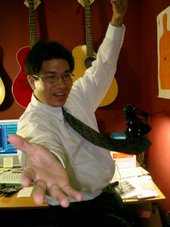
So. Here I am, living on my own, looking out for Numero Uno. I've taken steps to ensure that I'll be OK when I retire...but what about until then? What do I want to do with the next 40 years of my life?
I told my mom years ago that I wanted to do everything, and so far I've lived up to that. Back in elementary school I was voted "most artistic" of my class, and through high school and college I pursued my art skills to where I was actually "publishing" a web-comic once every week (for a short-lived six weeks). At the same time, I took music lessons, first learning piano and then moving on to the guitar, eventually forming an actual rock band and performing in college. At one point, I was a paper aerospace engineer. As to my active side, I started in baseball, moved onto soccer, learned how to ski and snowboard, took up ultimate frisbee, got into tennis, and finally jumping whole-heartedly into cycling. Lately I have picked up target practice. I am a computer programmer by day.
So who am I really? What is it that I really want to do? What is it that I really like? I watch TV, read the internet, and see all of these people who have specialized in one thing and been successful at it. I find myself thinking "I could do that", then I jump in and for a while (a few months, perhaps a year) I actually do that, but then something new catches my fancy and I'm off to another thing.
Maybe that's my real hobby, my real pastime--a meta-pastime, as it were: to jump into as many pastimes as possible, to take them as far as I can, plateau, and then jump into something else. Lately, it's been the stock market; I read Rich Dad, Poor Dad and suddenly, in the span of about a week, I've become a gazillion times more financially literate than I was just a week ago, and odd phrases like "refinancing" and "what has your money done for you today?" take on new meaning.
But I know myself well enough now: in a year, maybe even a few months, I'll be back to searching for a new hobby, a new craving of knowledge to fill. Maybe it'll be skydiving or scuba diving or...I dunno. Who knows.
And I'm worried: will it be this way forever? Will I never find something, settle on it and say "this is it--I can do this for the rest of my days"?
I'm flailing about right now, casting around for things to do, while trying to reorganize a little bit. I've sold off a guitar and an amp and some other gear to simplify a bit, but then I've started pursuing music again. I fired up a childhood computer game (Tanarus) that used to consume, literally, half my waking hours to play (sorta like the MMORPGs, but this one is more action-oriented, driving tanks around). I've contemplated getting back into airplanes and art.
But what am I really looking for? What do I want to accomplish in the next 40 years? In the next 20? 10? 5? In the next year, where do I want to be?
Friday, January 25, 2008


Wednesday, January 2, 2008
Kent And Guns: The Early History
I've always been interested in target practice.
I grew up in the 90's, where toy laser guns and Nerf guns ruled the day, although I did have a cap gun and one of those "tracer guns" that shoot the penny-sized plastic discs. I remember setting up paper cups and trying to knock them down with nerf guns that shot ping-pong balls. I even got in big trouble once when I found a perfect Y-shaped piece of wood, stretched a rubber-band across it, set up a crate as a target, and missed the crate and put a rock through the glass sliding door behind the crate.
Then, when I was 17 or 18, my dad handed me down his air gun, a Crossman 1377--one of the older, unrifled ones that could shoot BBs both and pellets. It had faulty O-ring, so the compressed air would leak. Then I repaired it and took to shooting all sorts of stuff--filling the barrel with water and shooting off a nice mist, blowing the dust out of my computers with it, etc. Unfortunately, my dad wasn't into guns (even though he owned--and still owns--a single-shot 12-gauge), and he placed little emphasis on safety, trusting that I was mature and would use my common sense to stay safe. I didn't know anything about safety. I was a dumb, naive kid with an air pistol, and no respect for weapons or their deadly power.
I'm still ashamed to tell this next part, but I'll tell it anyways because it needs to be told. I found that I could stick a Golf tee in the muzzle of the barrel, kinda like one of those rifle-fired grenades, where they stick a grenade on the end of a rifle, firing blanks to launch the grenade. This made for cheap ammo, since my dad was into Golf at the time and I could find a tee anywhere in the house. Plus, they were recoverable, so I could use them over and over again. One day I loaded one up and, with just one pump, I was able to arc the tee from the foyer in my parents house to my brother's room upstairs, where it struck my brother on the side of his head (evidently, not with the pointy part). It wasn't an aimed shot--I didn't intend to hit him, I just wanted to lob the tee into his room. Just to see if I could. Then, not having learned any sort of lesson from his anger, I shot my cousin's dog with another tee and a similar power level. This was the last straw. My dad took back his heirloom and threw it away. The dog, well, we've made amends--she still comes up to me (but not for the week after the shooting--she would hide in her transportation cage if I was around).
Finally I learned my lesson, or at least I didn't have the air pistol with which to make that mistake again. I went off to college and, in my junior year, one of my roommates brought back a PVC-pipe marshmallow blow-gun. Finally, here was a gun and ammo I could actually shoot people with and not have to worry about deadly consequences. I jumped right in, improving on the design to use a piston and a cylinder to deliver more power do it more consistently than lung power. I also changed the format of the gun, from a glorified blow gun (with a pair of handles for the hands and a barely aim-able shape) to a simple long-gun, with a butt-stock and a forearm. It was much more accurate and powerful and easier to operate (it depended on arm-strength rather than lung-strength) and could be fired in a wider variety of positions. I even figured out how to add a sleeve inside the barrel that had rifling, which might improve the accuracy of the marshmallows.
But it still wasn't the real thing.
Fast forward a few years: I've graduated and started a full-time job. At this job, one of the guys I worked with invited me to go shooting with him. With real guns. With real bullets. At a real range. I went to his house and, after running through a bunch of safety rules, he showed me what we would be shooting: another coworker's guns, a Heckler & Koch P7M10 and a Glock 21. We went over the manual of arms for a bit and practiced dryfiring. This time there was no immaturity. Here were real weapons that could be used to actually kill something with. Not just the varying degrees of lethality of the Crossman 1377, no; if you pull the trigger on one of these while it's pointing at a person, there would be no question that that person would die. Finally, I was experiencing the maturity and respect for the weapons I should have had, all those years ago. I was conscious of where the muzzle was pointing, ensuring that I would not "sweep" anyone while dryfiring, keeping my finger off the trigger and planted firmly on the frame until the sights were lined up.
Then we got to the range and I read each and every rule I had to sign off on twice to make sure I knew them before handling live ammunition. While we were doing this, I was buzzing with excitement and nervousness. I could hear the gunfire from the range, I could smell the burnt powder.
We paid for an hour of range-time, a few targets, 100 rounds of ammunition for each of us, donned our Eyes and Ears, and went out onto the range. My coworker clipped up his target, sent it out, and loaded one of the P7's magazines with 10 rounds and put them all downrange. Then, slide locked back and the gun on the table, he turned to me and gestured: "your turn". I stepped up to the table, loaded the magazine as he had--wow, was that painful--picked up the gun (finger off the trigger), slapped in the magazine, squeezed the grip and savored the feeling. I saw it in my mind's eye: the slide moved forward, stripped a round off the top of the magazine and pushed it into the chamber, while a split second later, the next round was pushed to the top of the magazine. In that split second, I felt all of this and heard it and knew, for the first time in my life:
I was ready to fire.
I lined up the sights, right on the X, right in the middle of the silhouette, and squeezed the trigger. In that instant, between the time the slide started to cycle back to the time the slide stopped moving forward, I knew this is for me. With a grin, I enjoyed the rest of the hour, even besting my coworker in an impromptu accuracy match. First time out shooting. And no, this wasn't with cheap, light .22LR--this was with full-recoil, service-grade .40S&W.
That first time was almost two years ago. Now, target practice has become one of my favorite (if most expensive) past-times, and I embrace everything to do with it, from the tools and technology to the ammunition to the culture, and even the political aspects.
I have found something truly unique in my little world, and I have no intention of ever letting it go.
I grew up in the 90's, where toy laser guns and Nerf guns ruled the day, although I did have a cap gun and one of those "tracer guns" that shoot the penny-sized plastic discs. I remember setting up paper cups and trying to knock them down with nerf guns that shot ping-pong balls. I even got in big trouble once when I found a perfect Y-shaped piece of wood, stretched a rubber-band across it, set up a crate as a target, and missed the crate and put a rock through the glass sliding door behind the crate.
Then, when I was 17 or 18, my dad handed me down his air gun, a Crossman 1377--one of the older, unrifled ones that could shoot BBs both and pellets. It had faulty O-ring, so the compressed air would leak. Then I repaired it and took to shooting all sorts of stuff--filling the barrel with water and shooting off a nice mist, blowing the dust out of my computers with it, etc. Unfortunately, my dad wasn't into guns (even though he owned--and still owns--a single-shot 12-gauge), and he placed little emphasis on safety, trusting that I was mature and would use my common sense to stay safe. I didn't know anything about safety. I was a dumb, naive kid with an air pistol, and no respect for weapons or their deadly power.
I'm still ashamed to tell this next part, but I'll tell it anyways because it needs to be told. I found that I could stick a Golf tee in the muzzle of the barrel, kinda like one of those rifle-fired grenades, where they stick a grenade on the end of a rifle, firing blanks to launch the grenade. This made for cheap ammo, since my dad was into Golf at the time and I could find a tee anywhere in the house. Plus, they were recoverable, so I could use them over and over again. One day I loaded one up and, with just one pump, I was able to arc the tee from the foyer in my parents house to my brother's room upstairs, where it struck my brother on the side of his head (evidently, not with the pointy part). It wasn't an aimed shot--I didn't intend to hit him, I just wanted to lob the tee into his room. Just to see if I could. Then, not having learned any sort of lesson from his anger, I shot my cousin's dog with another tee and a similar power level. This was the last straw. My dad took back his heirloom and threw it away. The dog, well, we've made amends--she still comes up to me (but not for the week after the shooting--she would hide in her transportation cage if I was around).
Finally I learned my lesson, or at least I didn't have the air pistol with which to make that mistake again. I went off to college and, in my junior year, one of my roommates brought back a PVC-pipe marshmallow blow-gun. Finally, here was a gun and ammo I could actually shoot people with and not have to worry about deadly consequences. I jumped right in, improving on the design to use a piston and a cylinder to deliver more power do it more consistently than lung power. I also changed the format of the gun, from a glorified blow gun (with a pair of handles for the hands and a barely aim-able shape) to a simple long-gun, with a butt-stock and a forearm. It was much more accurate and powerful and easier to operate (it depended on arm-strength rather than lung-strength) and could be fired in a wider variety of positions. I even figured out how to add a sleeve inside the barrel that had rifling, which might improve the accuracy of the marshmallows.
But it still wasn't the real thing.
Fast forward a few years: I've graduated and started a full-time job. At this job, one of the guys I worked with invited me to go shooting with him. With real guns. With real bullets. At a real range. I went to his house and, after running through a bunch of safety rules, he showed me what we would be shooting: another coworker's guns, a Heckler & Koch P7M10 and a Glock 21. We went over the manual of arms for a bit and practiced dryfiring. This time there was no immaturity. Here were real weapons that could be used to actually kill something with. Not just the varying degrees of lethality of the Crossman 1377, no; if you pull the trigger on one of these while it's pointing at a person, there would be no question that that person would die. Finally, I was experiencing the maturity and respect for the weapons I should have had, all those years ago. I was conscious of where the muzzle was pointing, ensuring that I would not "sweep" anyone while dryfiring, keeping my finger off the trigger and planted firmly on the frame until the sights were lined up.
Then we got to the range and I read each and every rule I had to sign off on twice to make sure I knew them before handling live ammunition. While we were doing this, I was buzzing with excitement and nervousness. I could hear the gunfire from the range, I could smell the burnt powder.
We paid for an hour of range-time, a few targets, 100 rounds of ammunition for each of us, donned our Eyes and Ears, and went out onto the range. My coworker clipped up his target, sent it out, and loaded one of the P7's magazines with 10 rounds and put them all downrange. Then, slide locked back and the gun on the table, he turned to me and gestured: "your turn". I stepped up to the table, loaded the magazine as he had--wow, was that painful--picked up the gun (finger off the trigger), slapped in the magazine, squeezed the grip and savored the feeling. I saw it in my mind's eye: the slide moved forward, stripped a round off the top of the magazine and pushed it into the chamber, while a split second later, the next round was pushed to the top of the magazine. In that split second, I felt all of this and heard it and knew, for the first time in my life:
I was ready to fire.
I lined up the sights, right on the X, right in the middle of the silhouette, and squeezed the trigger. In that instant, between the time the slide started to cycle back to the time the slide stopped moving forward, I knew this is for me. With a grin, I enjoyed the rest of the hour, even besting my coworker in an impromptu accuracy match. First time out shooting. And no, this wasn't with cheap, light .22LR--this was with full-recoil, service-grade .40S&W.
That first time was almost two years ago. Now, target practice has become one of my favorite (if most expensive) past-times, and I embrace everything to do with it, from the tools and technology to the ammunition to the culture, and even the political aspects.
I have found something truly unique in my little world, and I have no intention of ever letting it go.
Tuesday, January 1, 2008
Song for a New Year
"Song for a New Year"
Song by Dispossessed
it's a new year
time for us to start again
it's a new year
time we all remembered where we've been
it's a new year
time for us to set things right
it's a new year
even if they won't change overnight
and I can't help but have the feeling that someday we'll all be good
and I can't help but have the feeling that it will all be as it should
and I can't help but have the feeling that it is time to start again
and I can't help but have that feeling now that I'm here with all my friends
it's a new day
forget all your ugly pain
it's a new day
look ahead; wash away the rain
it's a new day
things are sure to change, you'll see
it's a new day
and we don't know what it will be
and I can't help but have the feeling that someday we'll all be good
and I can't help but have the feeling that it will all be as it should
and I can't help but have the feeling that it is time to start again
and I can't help but have that feeling now that I'm here with all my friends
'cause things will change
we will grow
we're okay
and time will flow
we're all here
when I leave now
we're doin' great
we've made it through somehow
and it's a new year
time for all to make amends
it's a new year
never too late to start again
it's a new year
even if we won't change overnight
it's a new year
time for us to set things right
it's a new year...
Song by Dispossessed
it's a new year
time for us to start again
it's a new year
time we all remembered where we've been
it's a new year
time for us to set things right
it's a new year
even if they won't change overnight
and I can't help but have the feeling that someday we'll all be good
and I can't help but have the feeling that it will all be as it should
and I can't help but have the feeling that it is time to start again
and I can't help but have that feeling now that I'm here with all my friends
it's a new day
forget all your ugly pain
it's a new day
look ahead; wash away the rain
it's a new day
things are sure to change, you'll see
it's a new day
and we don't know what it will be
and I can't help but have the feeling that someday we'll all be good
and I can't help but have the feeling that it will all be as it should
and I can't help but have the feeling that it is time to start again
and I can't help but have that feeling now that I'm here with all my friends
'cause things will change
we will grow
we're okay
and time will flow
we're all here
when I leave now
we're doin' great
we've made it through somehow
and it's a new year
time for all to make amends
it's a new year
never too late to start again
it's a new year
even if we won't change overnight
it's a new year
time for us to set things right
it's a new year...
Monday, December 17, 2007
What Makes A Good Gift?
So about this time last year I was getting my gift-giving act together. I managed to still give some crap-tacular gifts, but I was definitely refining my approach: I would buy the gifts online this year and avoid the absolute circus of the local malls and stores--in this regard, I did well. I had all of my shopping done earlyish (by more than a week or so) and I had all the presents under the tree by Christmas Morning.
This year, I think I got the formula down-pat. So I give you my General Guidelines for Getting Good Gifts:
1. The gift should be something that the gift giver wants for himself/herself. This ensures that a gift was acquired with consideration and forethought. When I was rationalizing gifts, I constantly thought, "Would I want this for myself?" It prevented me from getting some truly useless gifts, like last year's Magnet Desk Toy. The guideline also ensures that the gift is representative of the giver--when the recipient gets the gift and uses it or otherwise enjoys it, they will be sharing in something that the gift giver would also use or otherwise enjoy.
2. The gift should be something that the recipient would want or use for himself/herself. This ensures that a gift will not spend undue time in its box in a cupboard, or collect dust high-up on a shelf somewhere. The rule will prevent awkward phone conversations: "How did you like your salad-tosser?" "Oh, it was nice, thanks."
3. The gift should be something that the recipient would not easily obtain on his/her own. The reasons for the recipient not obtaining the gift on their own can be as simple as "it would be too extravagant a purchase to justify spending the money" or as complicated as "it'd be nice, but I'm quite happy with..." or something like "the recipient wouldn't be able to afford it due to their income situation". Whatever the case, this rule ensures that it is truly a gift, not just a glorified stocking-stuffer.
There we have it, my three General Guidelines to Getting Good Gifts. Participating in the consumerism of Christmas is meaningless unless there's a good reason for it, and this year, with these rules, I am genuinely proud of the gifts I've gotten for people.
I feel that I have given them parts of myself, that on Christmas Morning they will unwrap their presents and find bits of me.
This year, I think I got the formula down-pat. So I give you my General Guidelines for Getting Good Gifts:
1. The gift should be something that the gift giver wants for himself/herself. This ensures that a gift was acquired with consideration and forethought. When I was rationalizing gifts, I constantly thought, "Would I want this for myself?" It prevented me from getting some truly useless gifts, like last year's Magnet Desk Toy. The guideline also ensures that the gift is representative of the giver--when the recipient gets the gift and uses it or otherwise enjoys it, they will be sharing in something that the gift giver would also use or otherwise enjoy.
2. The gift should be something that the recipient would want or use for himself/herself. This ensures that a gift will not spend undue time in its box in a cupboard, or collect dust high-up on a shelf somewhere. The rule will prevent awkward phone conversations: "How did you like your salad-tosser?" "Oh, it was nice, thanks."
3. The gift should be something that the recipient would not easily obtain on his/her own. The reasons for the recipient not obtaining the gift on their own can be as simple as "it would be too extravagant a purchase to justify spending the money" or as complicated as "it'd be nice, but I'm quite happy with..." or something like "the recipient wouldn't be able to afford it due to their income situation". Whatever the case, this rule ensures that it is truly a gift, not just a glorified stocking-stuffer.
There we have it, my three General Guidelines to Getting Good Gifts. Participating in the consumerism of Christmas is meaningless unless there's a good reason for it, and this year, with these rules, I am genuinely proud of the gifts I've gotten for people.
I feel that I have given them parts of myself, that on Christmas Morning they will unwrap their presents and find bits of me.
Tuesday, December 4, 2007
Moving Out, Moving On
Look at this stuff-
Isn't it neat?
Wouldn't you think my collection's complete?
So, for better or for worse, I'm moving into my parents' townhouse, four miles away from my parents' house (and my true home for the past two decades). I am officially on my own, and come next year (when I turn 25) I'll really be on my own.
It doesn't really jive with my lifestyle, although it's a significant step towards independence; I'm still paying someone else's mortgage (my parents'), but I'll be responsible for everything that happens with the place now: repairs, upgrades, the utilities, any roommate situations. It's all mine.
It's a townhouse, so I'll have neighbors to be considerate of (not so much as my leaves blowing onto their lawn, but more of my drumming and guitar-ing being too loud for them). And I've spent a lot of time painting in that house, so I have an idea of the kind of people who live there and the area: It's close to the airport, so planes passing overhead will be loud, and a younger crowd lives there, so cars passing by will share their music/exhaust noise. But I'm used to that--I did live in a college town for two years, after all.
Then there's my cycling concerns: I'd still like to be able to ride into work, and this new place lengthens my commute (if I were to take the same path) significantly--it would add about 20 to 30 minutes each way. There are alternate routes, but I feel safest with separated facilities (i.e. trails). It's also further to get to the W&OD trail, my main stomping grounds for riding. On the flip side, if I'm further away from civilization, I would get more quality ride-time on country roads.
In reference to the lyrics above, I've started to move my stuff in. All my toys are going to go. I need to get a safe for the more "adult" toys, but they're all going to live with me in my new house.
My new place. My place. No longer "my parents' place" (although technically it still is "my parents'" place).
I'm not apprehensive--it's just the next stage, a natural progression.
Isn't it neat?
Wouldn't you think my collection's complete?
So, for better or for worse, I'm moving into my parents' townhouse, four miles away from my parents' house (and my true home for the past two decades). I am officially on my own, and come next year (when I turn 25) I'll really be on my own.
It doesn't really jive with my lifestyle, although it's a significant step towards independence; I'm still paying someone else's mortgage (my parents'), but I'll be responsible for everything that happens with the place now: repairs, upgrades, the utilities, any roommate situations. It's all mine.
It's a townhouse, so I'll have neighbors to be considerate of (not so much as my leaves blowing onto their lawn, but more of my drumming and guitar-ing being too loud for them). And I've spent a lot of time painting in that house, so I have an idea of the kind of people who live there and the area: It's close to the airport, so planes passing overhead will be loud, and a younger crowd lives there, so cars passing by will share their music/exhaust noise. But I'm used to that--I did live in a college town for two years, after all.
Then there's my cycling concerns: I'd still like to be able to ride into work, and this new place lengthens my commute (if I were to take the same path) significantly--it would add about 20 to 30 minutes each way. There are alternate routes, but I feel safest with separated facilities (i.e. trails). It's also further to get to the W&OD trail, my main stomping grounds for riding. On the flip side, if I'm further away from civilization, I would get more quality ride-time on country roads.
In reference to the lyrics above, I've started to move my stuff in. All my toys are going to go. I need to get a safe for the more "adult" toys, but they're all going to live with me in my new house.
My new place. My place. No longer "my parents' place" (although technically it still is "my parents'" place).
I'm not apprehensive--it's just the next stage, a natural progression.
Monday, October 8, 2007
Sea Gull Century 2007
My goal was to start earlyish, and finish by 3PM. My game plan: find people who are going fast and draft as much as possible. Well, it turns out that the guy I roomed with had a similar plan, so when we started, we got in this huge paceline, probably 30 riders, and just booked it outta Salisbury. The paceline was interesting: the guy in the front would pull for about 5 minutes, then drop out and the next guy would take over, and the riders would keep cycling that way. In the line, we got up to 23mph, which was the top of my sustainable speed, so when it came to my turn to pull, I could only maintain it for 3 minutes before I had to drop back.
So the Sea Gull/Assateague Century is only a "century" (or 100 miles) if you actually stop at each rest stop (notably, the first). Well, the paceline I was in skipped the first, at 20 miles, which was a 2-mile detour from the main path, and we booked it to the 35-mile rest stop, which only had water and Gatorade. By about this time, I realized that I had neglected to bring any food, so I dropped off at the 35-mile rest stop (and the paceline kept going to the 60-mile rest stop), got some Gatorade, used the bathroom, and started off again on my own after a 10-minute stop.
For the first 50 miles of the ride, we were riding through fairly dense fog, with a visibility of maybe 25 yards. When you're riding at 20mph, 25 yards is not a long distance. The 100% humidity was good for hydration (breathing in moisture meant I didn't really need my water bottles that much) but bad for visibility. About 4 miles after the 35-mile stop, after going through all sorts of bumpy road (thoughts of the Roubaix ride in France, where bikes need to be made out of really-strong stuff, lest the cobblestones literally shake the bikes to pieces, were going through my head) and not being really sure whether I was on the path or not, I thankfully came up to a marked turn (they had white spraypainted seagulls on the road with arrows indicating the direction of travel). This turn was at a "T" in the road. Y'know at turns in the road, there are places where cars go, and where they don't go collects all sorts of gravel? Well my line took me through one of those patches of gravel...but I didn't see it and I wiped out! Scraped up my shin, bruised my hip, and scratched my until-then-pristine bike. As I was shaking myself off, more riders were coming up to the turn, so I yelled at them "GRAVEL! GRAVEL!" and, even with the warning, not 5 minutes after I wiped out, another rider wiped out in the same way.
He and I were OK, and we both jumped into the same 4-person paceline, taking it a little easier at 19.5mph, and when the next turn came up, everyone played it safe and took the turn at maybe 14mph. I stayed in that line until the 60-mile stop. I don't quite remember how I managed to do that, because a rock had lodged itself in my left brifter and was making shifts and braking less responsive--the front brake caliper wouldn't release all the way, causing rubbing, and the it was hard to shift the front derailleur. Thankfully, at our slower pace, I was able to get away with opening the Quick-Release on the front brake caliper, and I didn't need my large chainring at all (whereas when I was in that first paceline, the only way I kept up at all was by sitting in the large chainring the whole time), just stayed in the middle ring, and I was fine.
Got to the 60-mile rest stop at Assateague Island (after crossing that bridge and dodging all the horse manure). By then the Sun had come out and started to beat away all of the fog. At this stop there were lots of cookies, baked goods, fruits...so I gorged myself on the food, got some water to wash out my scrapes, and grabbed some packaged Fig Newtons for trailfood, and started off again after resting for 15 minutes to let the food have time to work. This time I joined up with rider #3056 and we double-teamed it to the 80-mile stop.
TO ANYONE DOING THE SEA GULL CENTURY: THERE IS PIE AND ICE CREAM AT THE 80-MILE STOP! The guy I was rooming with didn't know, and he apparently blew by it, but #3056 and I stopped and had a slice of pie and some ice cream and filled up on liquids. We started off again after 10ish minutes, and found two more riders for our paceline, still going at almost 20mph.
During this final 20-mile leg, we were being passed by teams and huge pacelines, but no one felt any pressure to link-up and go any faster, which was good because the sun was out in-full by now and we could enjoy the sights (and smells!) of rural Eastern Shore, Maryland (I commented "Ah, feels like I'm back in Blacksburg!"). All the while, we were still doing our paceline thing, with (maybe) 5-minute pull-rotations (it wasn't anything official, but that's how it worked out). On my second pull, I got to the front of the pack and basically set my mental cruise-control to 20mph and set my cyclocomputer to show ride-time, after five minutes I would rotate out. Well, as I came up to a road crossing (most of the major thoroughfare roadcrossings had a police officer directing traffic, favoring the riders), I looked back...and it turned out that I had dropped my entire paceline. So I went slow, waiting for one of them to show up and I asked him, "Where'd everybody go?" and he said, "Well when you hit the gas, no one could keep up!" So he and I took turns pulling the other all the way back to the finish line.
At the 60-mile stop I took my phone out and saw I missed a call from my mom, which said my parents and my sisters were coming to Salisbury to cheer me on at the finish line. With almost perfect timing, they got to the line only 30 minutes before I showed up at 1PM! It was nice to have someone in the crowd there to cheer for me!
Statistics:
Saddle Time: 4h49m00s
Actual Time: ~5h30m (including all of the stops, and the 5-7 minutes after my wipeout)
Max Speed: 28.3mph
Avg Speed: 20.0mph
Distance: 96.33mi
After the ride we went to the Sage Diner for lunch, then my family went home and I went back to my hotel room to shower and crash for two hours. Then I joined Sridhar, Mike, and Jacob (the guy I roomed with) for a beer on-campus and to swap stories about the ride (this was about 5:30PM, and there were people still finishing the ride!). Evidently Jacob finished his ride in 4h30m (4h25m saddle-time, 5 minutes at the 60-mile stop), Sridhar had a saddle-time of 5h22m (my family and I saw him and cheered him on when we were heading out for food), and Mike finished...later.
Not too bad for my first century ride!
So the Sea Gull/Assateague Century is only a "century" (or 100 miles) if you actually stop at each rest stop (notably, the first). Well, the paceline I was in skipped the first, at 20 miles, which was a 2-mile detour from the main path, and we booked it to the 35-mile rest stop, which only had water and Gatorade. By about this time, I realized that I had neglected to bring any food, so I dropped off at the 35-mile rest stop (and the paceline kept going to the 60-mile rest stop), got some Gatorade, used the bathroom, and started off again on my own after a 10-minute stop.
For the first 50 miles of the ride, we were riding through fairly dense fog, with a visibility of maybe 25 yards. When you're riding at 20mph, 25 yards is not a long distance. The 100% humidity was good for hydration (breathing in moisture meant I didn't really need my water bottles that much) but bad for visibility. About 4 miles after the 35-mile stop, after going through all sorts of bumpy road (thoughts of the Roubaix ride in France, where bikes need to be made out of really-strong stuff, lest the cobblestones literally shake the bikes to pieces, were going through my head) and not being really sure whether I was on the path or not, I thankfully came up to a marked turn (they had white spraypainted seagulls on the road with arrows indicating the direction of travel). This turn was at a "T" in the road. Y'know at turns in the road, there are places where cars go, and where they don't go collects all sorts of gravel? Well my line took me through one of those patches of gravel...but I didn't see it and I wiped out! Scraped up my shin, bruised my hip, and scratched my until-then-pristine bike. As I was shaking myself off, more riders were coming up to the turn, so I yelled at them "GRAVEL! GRAVEL!" and, even with the warning, not 5 minutes after I wiped out, another rider wiped out in the same way.
He and I were OK, and we both jumped into the same 4-person paceline, taking it a little easier at 19.5mph, and when the next turn came up, everyone played it safe and took the turn at maybe 14mph. I stayed in that line until the 60-mile stop. I don't quite remember how I managed to do that, because a rock had lodged itself in my left brifter and was making shifts and braking less responsive--the front brake caliper wouldn't release all the way, causing rubbing, and the it was hard to shift the front derailleur. Thankfully, at our slower pace, I was able to get away with opening the Quick-Release on the front brake caliper, and I didn't need my large chainring at all (whereas when I was in that first paceline, the only way I kept up at all was by sitting in the large chainring the whole time), just stayed in the middle ring, and I was fine.
Got to the 60-mile rest stop at Assateague Island (after crossing that bridge and dodging all the horse manure). By then the Sun had come out and started to beat away all of the fog. At this stop there were lots of cookies, baked goods, fruits...so I gorged myself on the food, got some water to wash out my scrapes, and grabbed some packaged Fig Newtons for trailfood, and started off again after resting for 15 minutes to let the food have time to work. This time I joined up with rider #3056 and we double-teamed it to the 80-mile stop.
TO ANYONE DOING THE SEA GULL CENTURY: THERE IS PIE AND ICE CREAM AT THE 80-MILE STOP! The guy I was rooming with didn't know, and he apparently blew by it, but #3056 and I stopped and had a slice of pie and some ice cream and filled up on liquids. We started off again after 10ish minutes, and found two more riders for our paceline, still going at almost 20mph.
During this final 20-mile leg, we were being passed by teams and huge pacelines, but no one felt any pressure to link-up and go any faster, which was good because the sun was out in-full by now and we could enjoy the sights (and smells!) of rural Eastern Shore, Maryland (I commented "Ah, feels like I'm back in Blacksburg!"). All the while, we were still doing our paceline thing, with (maybe) 5-minute pull-rotations (it wasn't anything official, but that's how it worked out). On my second pull, I got to the front of the pack and basically set my mental cruise-control to 20mph and set my cyclocomputer to show ride-time, after five minutes I would rotate out. Well, as I came up to a road crossing (most of the major thoroughfare roadcrossings had a police officer directing traffic, favoring the riders), I looked back...and it turned out that I had dropped my entire paceline. So I went slow, waiting for one of them to show up and I asked him, "Where'd everybody go?" and he said, "Well when you hit the gas, no one could keep up!" So he and I took turns pulling the other all the way back to the finish line.
At the 60-mile stop I took my phone out and saw I missed a call from my mom, which said my parents and my sisters were coming to Salisbury to cheer me on at the finish line. With almost perfect timing, they got to the line only 30 minutes before I showed up at 1PM! It was nice to have someone in the crowd there to cheer for me!
Statistics:
Saddle Time: 4h49m00s
Actual Time: ~5h30m (including all of the stops, and the 5-7 minutes after my wipeout)
Max Speed: 28.3mph
Avg Speed: 20.0mph
Distance: 96.33mi
After the ride we went to the Sage Diner for lunch, then my family went home and I went back to my hotel room to shower and crash for two hours. Then I joined Sridhar, Mike, and Jacob (the guy I roomed with) for a beer on-campus and to swap stories about the ride (this was about 5:30PM, and there were people still finishing the ride!). Evidently Jacob finished his ride in 4h30m (4h25m saddle-time, 5 minutes at the 60-mile stop), Sridhar had a saddle-time of 5h22m (my family and I saw him and cheered him on when we were heading out for food), and Mike finished...later.
Not too bad for my first century ride!
Wednesday, August 29, 2007
Cycling
I've been riding pretty much non-stop for the past three weeks, probably averaging 15 miles per day. It feels good to be active, although I'm not really losing any weight.
I've noticed this about my weight loss: if I don't go to sleep right after (i.e. before I eat) some sort of work-out and make my weight-loss "stick", I'll tend to over-eat and blow away any "progress" I've made. Therefore, while morning rides (before breakfast/ride to breakfast) are good because it's cooler out and there is less traffic on the trail, evening rides (after dinner) are better because I can use up any extra calories I've ingested during the day. It explains why my DDR regimen worked so well.
All of this, of course, is in preparation for the Sea Gull Century, which is on October 6th, only five weeks away now. By then I hope to be able to at least ride to the start of the W&OD trail and back (a total of about 45 miles from where I live). It won't be quite like the 100 miles of flat, windy terrain the Sea Gull Century supposedly is, but it will have hills and road crossings and the like, so maybe it'll work out somehow.
I'm also a bit apprehensive about my equipment. I know it for sure now: my bike is "cheap" (even though it was $600 out-the-door) with cheaper components. It should suffice for the ride, but if I'm going to be serious about riding, my next bike will probably cost more than $1500. Still, it's a good "learner's bike": 27-speeds, Shimano Tiagra STI shifters/brakes ("brifters"), clipless pedals, road wheels and tires. When I'm done with it (probably after this season) I'll probably sell it.
It's just like with anything else: you get what you pay for.
I've noticed this about my weight loss: if I don't go to sleep right after (i.e. before I eat) some sort of work-out and make my weight-loss "stick", I'll tend to over-eat and blow away any "progress" I've made. Therefore, while morning rides (before breakfast/ride to breakfast) are good because it's cooler out and there is less traffic on the trail, evening rides (after dinner) are better because I can use up any extra calories I've ingested during the day. It explains why my DDR regimen worked so well.
All of this, of course, is in preparation for the Sea Gull Century, which is on October 6th, only five weeks away now. By then I hope to be able to at least ride to the start of the W&OD trail and back (a total of about 45 miles from where I live). It won't be quite like the 100 miles of flat, windy terrain the Sea Gull Century supposedly is, but it will have hills and road crossings and the like, so maybe it'll work out somehow.
I'm also a bit apprehensive about my equipment. I know it for sure now: my bike is "cheap" (even though it was $600 out-the-door) with cheaper components. It should suffice for the ride, but if I'm going to be serious about riding, my next bike will probably cost more than $1500. Still, it's a good "learner's bike": 27-speeds, Shimano Tiagra STI shifters/brakes ("brifters"), clipless pedals, road wheels and tires. When I'm done with it (probably after this season) I'll probably sell it.
It's just like with anything else: you get what you pay for.
Subscribe to:
Posts (Atom)